Trade Execution Templates
Specify order handling preferences, timing concepts, and routing rules that guide automated bots through dependable execution steps.
Next‑gen automation toolkit
NIS Profit System coordinates autonomous execution flows, real‑time monitoring dashboards, and rule‑driven controls that empower bots across multiple venues. The UI presents precise routing, sizing logic, and session settings for clear, repeatable operation. An AI guidance layer delivers concise context, actionable notes, and checkpoint markers to accelerate informed decisions.
NIS Profit System emphasizes structured configuration for automated trading bots, delivering consistent parameters that drive execution behavior. The feature set emphasizes clarity across routing, monitoring, and control layers, with AI-assisted trading support delivering organized summaries and workflow checkpoints. Each module is designed for repeatable setup across instruments and sessions.
Specify order handling preferences, timing concepts, and routing rules that guide automated bots through dependable execution steps.
AI-powered guidance crafts structured notes from configuration inputs, aligning parameters with intended operations.
View order states, exposure snapshots, and event logs in a unified dashboard designed for rapid assessment and easy navigation.
Manage active windows, throttle settings, and execution pacing to match preferred operating schedules.
Reuse configuration blueprints for repeated workflows, ensuring uniform setup across instruments, venues, and strategies.
Maintain structured activity records suited for review, including execution events, configuration changes, and session summaries.
NIS Profit System follows a clear sequence that links configuration inputs to automated trading bot behavior. The flow highlights parameter definition, execution preferences, and monitoring dashboards, supported by AI-powered trading assistance for structured summaries. Each step is presented as a repeatable workflow for consistent operational use.
Select instruments, sizing logic, and execution preferences that shape how automated trading bots interpret operational rules.
Set exposure caps, order pacing, and session boundaries so execution behavior stays aligned with configured limits and thresholds.
Enable automated trading bots to operate under the chosen templates, with AI-assisted summaries reflecting the active configuration.
Use consolidated dashboards and event records to track execution states, exposure snapshots, and workflow continuity.
NIS Profit System presents a curated set of operational areas that support automated trading bots and AI-assisted guidance. The progress bars illustrate feature coverage across configuration, execution controls, monitoring dashboards, and auditable logs. These indicators reflect overall scope and workflow completeness.
NIS Profit System provides clear, concise answers about automated trading bots, AI-guided trading assistance, and operational tooling. The items below describe how configuration templates, monitoring views, and execution controls integrate within a repeatable workflow. Each response emphasizes functionality and interface behavior.
NIS Profit System combines AI-guided trading assistance with automated bots that support configurable execution workflows, monitoring dashboards, and operational controls for market participation.
Configuration uses parameter templates covering instruments, sizing logic, routing preferences, and session behavior to create consistent execution steps for automated bots.
AI-assisted trading guidance generates structured summaries of active parameters, highlights configuration checkpoints, and organizes workflow notes for quick review.
Monitoring dashboards show order statuses, exposure snapshots, session context, and audit-friendly event logs that reflect automated bot activity.
Operational logs capture configuration changes and execution events in a structured format, enabling consistent review of automated trading workflows over time.
NIS Profit System centralizes configuration templates, monitoring dashboards, and AI-assisted guidance for automated bots. Follow a consistent setup path, apply operational controls, and maintain structured logs aligned with daily execution. Complete the registration form to proceed with access routing.
Open the enrollment formNIS Profit System offers configurable safeguards that shape automated trading bot behavior across sessions and instruments. These controls emphasize exposure limits, pacing, and operational safeguards, supported by AI-assisted summaries of active constraints. The cards below outline common configuration areas used in automation routines.
Set maximum exposure thresholds per instrument or session so automated bots operate within defined boundaries.
Configure pacing and throttling rules to shape execution cadence and maintain consistent behavior across time windows.
Define active windows and pause conditions that align automated bots with preferred operating schedules and reviews.
Use configuration templates and AI summaries to verify parameters before activating automation workflows.
Review structured logs and monitoring dashboards to keep operational awareness aligned with bot activity.
Apply preset constraints that bundle exposure, pacing, and session rules into a repeatable configuration.
NIS Profit System uses structured workflows to ensure consistent handling of configuration inputs, monitoring dashboards, and operational logs. The checklist highlights best practices for automated trading bots and AI-guided insights across execution routines. Each item reflects a workflow‑oriented approach to organized operations.
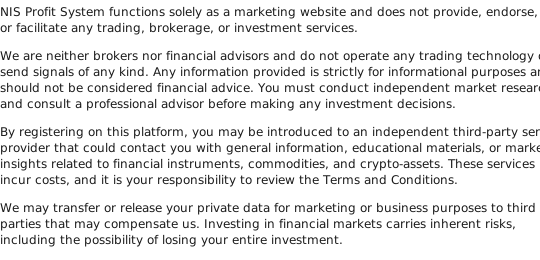
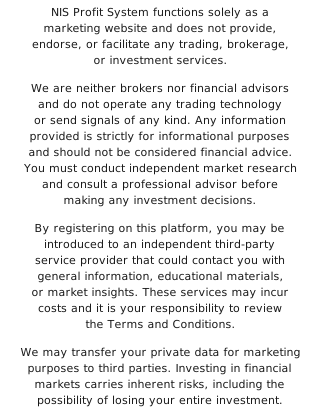
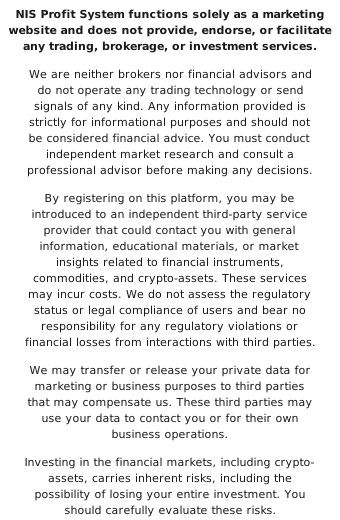
This site functions solely as a marketing profile and does not provide, endorse, or facilitate any trading, brokerage, or investment services.
Read More